

How AI Is Used in Business?
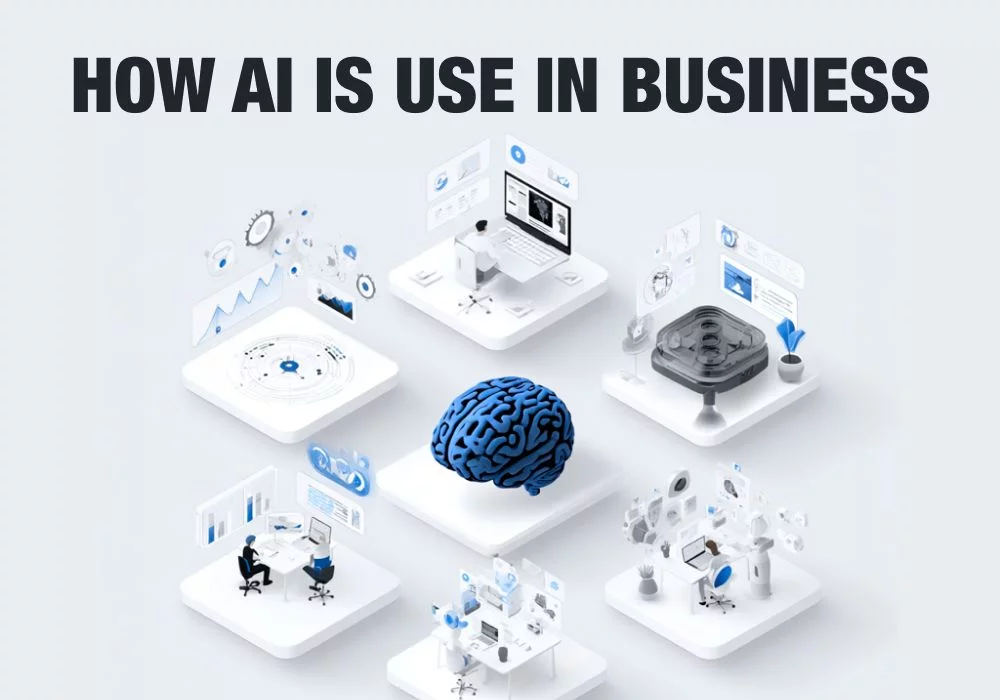
Artificial Intelligence AI is the new big thing adopted in businesses. It is simply the simulation of human intelligence in machines. AI in business systems is utilized as a tool to support the human workforce and streamline tasks. They are also designed to automate complex projects, analyze large datasets, and make accurate business decisions.
Quick navigation
- Brief overview of Artificial Intelligence (AI)
- Machine learning algorithms
- Deep learning
- Natural language processing (NLP)
- Computer vision
- Key Benefits of Artificial Intelligence in Business
- Improved Decision-Making
- Increased Efficiency
- Enhanced Customer Experience
- Cost Reduction
- Risk Management
- Innovation
- How Can Businesses Use AI?
- IT operations
- Marketing and Sales
- Customer Service
- Content Generation
- Cybersecurity
- Supply Chain Management
- Financial Analysis, Trading, and Fraud Detection
- Possible Risks of Using AI
- AI and Privacy
- Security Risks
- Faulty Decision Making
- Job Displacement
- Career in AI for Business
- AI Engineer
- Data Scientist
- Machine Learning Engineer
- AI Product Manager
- Business Intelligence Analyst
- Natural Language Processing (NLP) Specialist
- Ethical AI Specialist
- Robotics Engineer
- AI Research Scientist
- AI Trainer
- How Top Companies Use AI?
- Walmart
- Amazon
- Apple
- Siemens
- JP Morgan
- Pfizer
- Duolingo
- DHL
- Hilton Hotels
- Renty.ae
Brief overview of Artificial Intelligence (AI)
Essentially, artificial intelligence creates machines that can mimic human thought processes to ease business operations. These AI systems use organizations' data and tools like machine learning algorithms, computer vision, and others to build effective business strategies. As such, organizations need to understand how these AI tools work in real time:
Machine learning algorithms
Machine learning is a branch of AI that uses large data sets to predict specific outcomes. These algorithms are built to extract insights from complex data. Furthermore, businesses can use them to find errors, study patterns, and analyze complex structures.
Machine learning works in different ways. Some algorithms work with either labeled or unlabeled data, while others learn through their experiences. Regardless, these algorithms produce predictive analytics that organizational systems can use to boost operational efficiency and drive business success.
Deep learning
Deep learning is a vital machine learning technique that allows business systems to automate repetitive tasks seamlessly. These AI models collect accurate information, study continuous patterns, and mimic human behavior with precision when they process vast amounts of data. As such, they can be used to generate product recommendations and create virtual assistants for users.
Deep learning models also provide actionable insights for organizations by predicting future outcomes based on present-day market structure and user behavior. On the other hand, business systems across industries use these AI models to protect sensitive information, restrict unauthorized third parties, and counter fraud.
Natural language processing (NLP)
Natural language processing NLP allows computer systems to understand and communicate in human language. These systems can use NLP to perform advanced data analytics and translate insights into a simple format. NLP powers the business world by creating systems that can handle many customer queries and provide enhanced customer satisfaction.
NLP systems analyze large volumes of textual data. They give businesses a competitive edge by quickly identifying trends and needs. NLP also generates insights for content creation and analyzes audio data to create voice recognition systems.
Computer vision
As the name implies, computer vision is a branch of AI that analyzes visual data. It creates business systems that generate information from both pictures and videos. Computer vision models are designed to process visual elements like humans. It uses cameras and sensors to study images for recurring patterns and paint an accurate picture of visual scenes.
Computer vision has transformed several business operations by combining data analytics and digital imagery. It can leverage AI tools like machine learning to build secure systems, detect irregularities, and optimize inventory management.
Key Benefits of Artificial Intelligence in Business
Most entrepreneurs have already implemented AI in their work, as the results prove to be convincing. Consider multiple benefits:
Improved Decision-Making
AI enables businesses and their leaders to make good decisions without spending time on market research. AI systems operate promptly — they can analyze market structures and predict outcomes based on customer engagement with products instantly. Organizations can use these analytics to make improved decisions and drive business success.
AI studies supply and demand systems in the market to help companies buy, sell, or close vital deals. With these AI solutions, companies can improve their products and business structures from time to time.
Increased Efficiency
AI implementation can enhance productivity and efficiency within an organization. Companies use them to process automation for tasks like email management, resource allocation, and data entry. Instead of manually completing these tasks, AI systems handle them within seconds, providing space for staff to express their creativity.
AI technologies analyze social media and other day-to-day tools to identify trends. Business leaders can use these tools to streamline workflow and create effective strategies.
Enhanced Customer Experience
AI models like chatbots and digital assistants have transformed customer relationship management across the business landscape. These AI technologies can interpret and respond to basic instructions in human language through texts and voice recordings.
Companies can enhance their products by using data from customers' experiences and behaviours, release new features based on people's feedback and requests, and make their product development process more data-driven.
Cost Reduction
The use of AI reduces management and operational costs in organizations, as it changes the nature of human intervention. Employees use AI to save time and reduce manual labor by automating repetitive tasks and analyzing complex data.
Furthermore, AI's transformative potential can enhance business operations and optimize workflow. They can also use it to allocate resources to staff, draft annual budgets, and predict potential faults to save the cost of repair, without compromising on security and privacy.
Risk Management
AI doesn't just process automation but also helps companies manage risks. It uses predictive analytics to study behavioral patterns in real time and detect inconsistencies and breaches in security systems. AI sends signals to warn companies about potential risks and how they can affect the business.
AI can help predict potential risks. So, companies no longer need to manually analyze large sets of data just to catch errors. Furthermore, these systems can extract vital information and familiar patterns from historical data, past performances, and other bulky data sets.
Innovation
Companies can use intelligent systems and generative AI tools to develop new ideas and create simulations of market structures. With these intelligence tools, organizations can analyze site usage or product demand to determine people's reactions. These tools collect insights by studying customer feedback, for example, on social media.
Over time, they can use these insights to develop their products and build advanced models that suit modern-day business needs. AI also accelerates the research and development process in these companies, as it detects trends to give them a competitive advantage.
How Can Businesses Use AI?
The use of artificial intelligence in business is rapidly evolving, and its influence cuts across multiple sectors. Companies now apply AI technologies to improve customer experiences, reduce costs, boost productivity, and prevent security threats.
There are countless other benefits of artificial intelligence in business. Here are some business sectors that benefit from AI applications:
IT operations
Businesses use artificial intelligence concepts like deep learning, ML algorithms, and NLP to create seamless IT operations. With AI precise analytics, IT teams in companies can collect insights instantly and apply them to the necessary areas. Essentially, IT teams can use these intelligent systems to reduce stress and minimize human error.
Marketing and Sales
Marketing and sales departments are responsible for detecting modern trends and keeping up with market conditions. Leveraging AI can help these teams create effective strategies and study competitions within their industries promptly. Additionally, companies also use these models to develop customer relationship management and create products that align with their needs.
Customer Service
Businesses can leverage AI to create responsive systems and chatbots that work around the clock. These systems are built to provide support and ultimately build customer engagement. This allows team members and business owners to spend their time solving other intricate issues.
Content Generation
AI helps businesses to simplify the content creation process. With tools like generative AI, companies can generate visual or textual ideas for their next content. This content can be used to create effective marketing strategies like structured campaigns and business proposals.
Cybersecurity
AI can analyze network systems and sensitive data to detect inaccuracies. These systems can predict potential security breaches, detect weak points, and even counter fraudulent activities. As such, companies invest in AI to protect systems by implementing advanced security measures.
Supply Chain Management
In more than one way, AI can improve operational efficiency within a business. Companies use these systems to manage their inventory and maintain the appropriate tools needed for operations. They also help business owners to assign roles to employees and predict the cost of products.
Financial Analysis, Trading, and Fraud Detection
AI can be used to analyze trading risks and predict financial outcomes for businesses in different industries. Business owners and investors can take advantage of these systems to determine the best time to take action. Additionally, they also provide security insights for organizations as they can detect suspicious activities and potential fraud beforehand.
Possible Risks of Using AI
While AI serves many benefits to both business owners and investors, there are also potential risks to look out for. These risks often include privacy breaches, poor decision-making, security risks, etc. Additionally, employing AI to develop business systems may raise ethical and legal concerns in competitive marketplaces.
AI and Privacy
Without proper control and adequate management of these AI systems, users risk having their data leaked to third parties or exploited by companies. As such, businesses must comply with regulatory bodies like the GDPR to make users feel safe.
Security Risks
In the coming years, AI poses major security risks to both organizations and individuals. As a result, companies need to take counteractive measures like encrypting sensitive data and investing in advanced cybersecurity solutions.
Faulty Decision Making
Business owners tend to rely on AI analysis and predictions to make decisions these days. Poor maintenance and auditing can cause these systems to generate incorrect reports and faulty insights, leading to bad business decisions. Companies need to fully examine these systems to ensure 100% accuracy.
Job Displacement
AI is predicted to replace repetitive roles like data entry, analysis, and visualization jobs, and others in the business industry. Employees with these roles are at risk of losing their jobs to AI in the coming years. Hence, they need to develop new skill sets and knowledge to become indispensable within the market.
Career in AI for Business
AI Engineer
An AI engineer is responsible for building and programming intelligence systems. AI engineers create these systems to mimic human behavior, solve complex tasks, and provide intelligent support in several areas of business. These engineers work with extensive datasets and algorithms.
Data Scientist
Data scientists are professionals that can examine intricate datasets to generate insights. They use AI concepts to predict outcomes and help business leaders take action at the right time.
Machine Learning Engineer
ML engineers build complex algorithms and intelligent programs from the ground up to interact with machines. They also create predictive models for businesses to detect patterns, predict outcomes, and protect sensitive data from fraud and unauthorized third parties.
AI Product Manager
The role of an AI product manager is to oversee the production and implementation of intelligence models into businesses. The product manager connects the investors and operations unit within an organization, communicating their needs to each other.
Business Intelligence Analyst
Business intelligence analysts can detect present trends and study customer behavior using intelligence models. These tools allow them to create insights that can improve business structures.
Natural Language Processing (NLP) Specialist
NLP specialists can help businesses interact with their customers and audience in human language. They apply these concepts to create voice recognition systems, chatbots, and digital assistants to help companies provide support to their users.
Ethical AI Specialist
These are specialists that ensure that companies stick to ethical guidelines when using AI in their operations. As such, they respond to privacy breaches, transaction discrepancies, and other ethical challenges.
Robotics Engineer
A robotics engineer integrates AI into physical machines like smart appliances and others. These engineers can build smart machines that can help businesses by reducing workload and improving efficiency.
AI Research Scientist
Research scientists work constantly with AI concepts to find areas that need development. They also develop algorithms using multiple programming languages.
AI Trainer
AI trainers spend time training intelligence systems using human input and language. These trainers help the systems understand natural language and respond to users promptly.
How Top Companies Use AI?
Walmart
Being a retail store, Walmart uses AI to predict demand in the market and analyze customer behavior. These systems help them to make better decisions.
Amazon
Amazon uses AI to majorly optimize logistics and analyze large sets of data. As a result, people can find products and shop within minutes.
Apple
With features like Siri, image generation, and other intelligence features, Apple can enhance user experience and provide advanced privacy settings. They recently developed Apple Intelligence — a smart tool that helps users use their devices more seamlessly.
Siemens
Siemens is an engineering company that focuses on automation and software. Today, Siemens uses AI to predict outcomes based on real insights and enhance the efficiency of existing infrastructures..
JP Morgan
Companies like JP Morgan use AI to protect their systems and detect fraud. AI also improves operations within the company and helps them build relationships with clients.
Pfizer
Scientists at Pfizer utilize AI to develop drugs, create detailed documents, and provide vital reports based on user's consumption.
Duolingo
Duolingo uses AI to create lessons and specific content that can help users learn their desired languages promptly. They use these systems to make learning more interactive and fun.
DHL
DHL uses AI-powered software to track logistics and predict future outcomes like shipping volumes, delivery delays, and optimal delivery routes. This helps DHL to provide better services to its customers.
Hilton Hotels
Hilton Hotels uses AI in more than one way. They are used to power chatbots, handle basic tasks like room selection, and so much more.
Renty.ae
Artificial Intelligence AI is no longer a stranger in the world of business. Renty is no exception in incorporating its use into their services. We stop at nothing when it comes to using modern technologies to enhance customer experience and optimize work processes.
Business processes at Renty integrate several AI tools:
-
Midjourney for generating visuals that help attract customers and showcase cars and yachts.
-
ElevenLabs for creating video content, which significantly saves time and effort.
-
ChatGPT and WhatsApp bots for processing client requests and creating content. This allows to respond to inquiries instantly and improve the interactions with clients.
The reasons for adopting the use of AI are not far-fetched. It provides Renty with competitive advantages and helps them reach a new level of service.
Renty.ae, as a company, always adapts to new trends and conditions. We are open to changes if they improve the work process and customer experience.